What Are Etsy Keywords?


Imagine a shopper types "gift for dog lover" into Etsy.
Thousands of listings could potentially match that search.
So how does Etsy decide which ones to show?
One of the biggest clues Etsy uses is keywords.
Keywords are the words and phrases shoppers type into the Etsy search bar.
.gif)
For example:
- “ceramic mug”
- “gift for dog lover”
- “personalized wedding sign”
These searches help Etsy decide which listings to show to shoppers.
That is why keywords matter so much.
Relevant keywords can help bring new customers to your shop:
- without paying for ads
- without already having followers
- and often at the exact moment somebody is ready to buy
Keywords help Etsy connect the right buyer with the right product, and you want to help Etsy understand when your listing is a good match.
But not all keywords are equally useful.
For example which of these three keywords would you pick for an Etsy listing?
"necklace", "14k gold laser engraved pendant", "morse code necklace"
At first glance, "necklace" looks like the obvious winner. Lots of shoppers search for it.
So why isn't everyone using it?
We need to look closer.
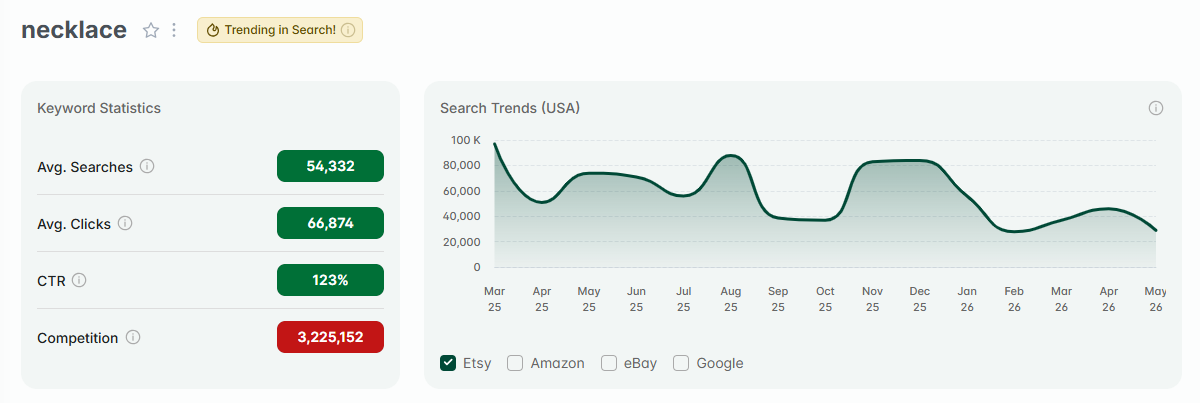
Lots of searches, but too broad. That is, it has high competition and lacks specificity. It will attract irrelevant traffic.
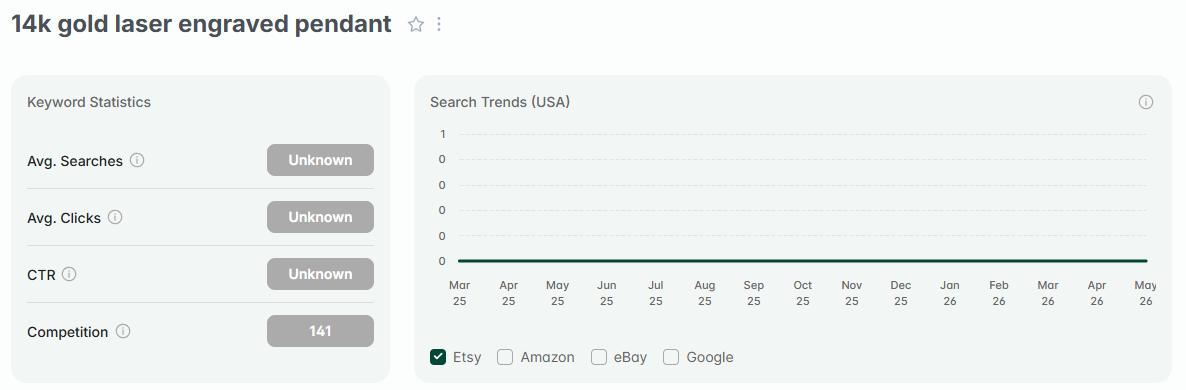
Better; it is more niche, more long-tail. But Keyword Tool shows that shoppers don’t use this phrase to search, it is “seller speak” not “buyer speak.”
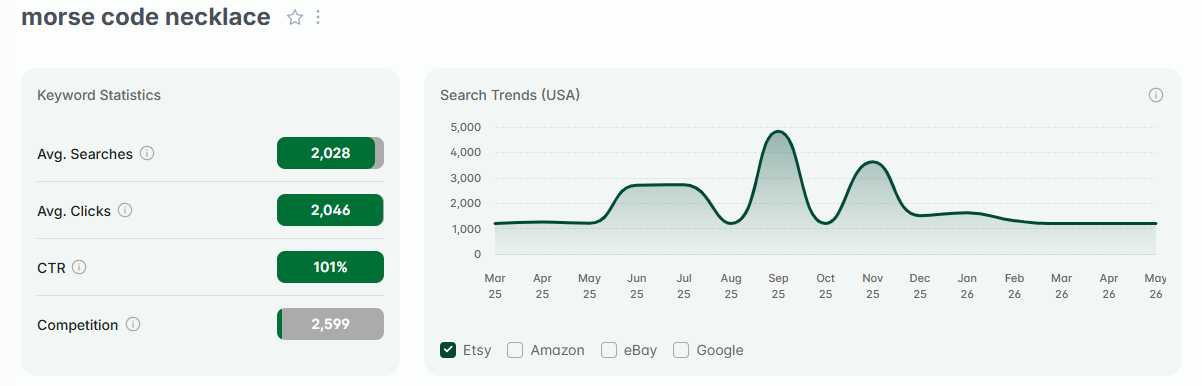
Strong! Keyword Tool confirms that many buyers use this term to search. It is specific, long-tail. That is, it will attract the shoppers who know what they want, who show more “purchase intent”
A strong keyword does more than show up in lots of shopper searches. It helps Etsy match your particular product to the right buyer at the right time. Customers with purchase intent, who are searching with the intention to buy, as opposed to those just browsing.
Keywords are the bridge between what you sell and what shoppers are searching for.
And understanding this is not just useful on Etsy.
Any platform with a search bar - Google, Pinterest, YouTube, TikTok - relies on keywords to help people discover content and products.
Learning how keywords work is a skill you can use almost anywhere online.
Pam Tip: After learning about Etsy keywords, I found it much easier to also grow my YouTube channel. Different platforms work in different ways, but understanding how people search gave me a huge head start.
So, before we start researching keywords, let’s look at what makes strong keyword.
The four factors that make a strong keyword
So how do you tell whether a keyword is actually worth targeting?
We use four simple tests.
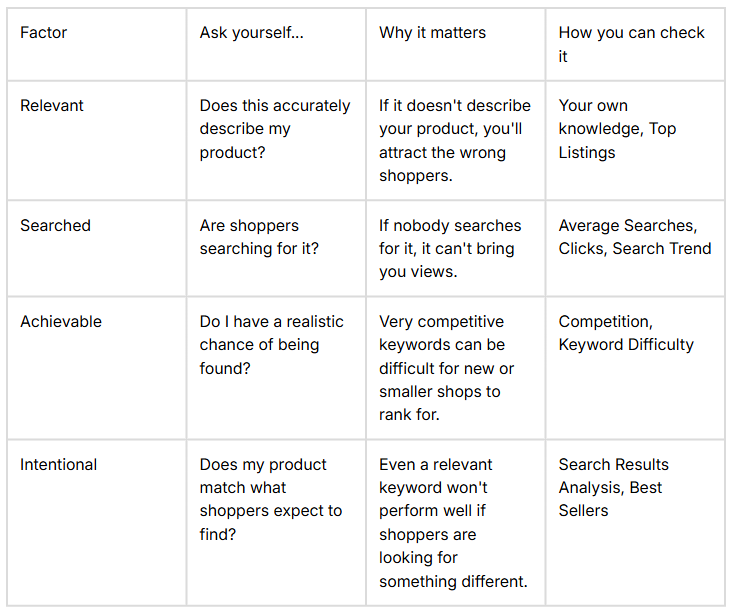
A keyword does not need to be perfect in every category. The strongest keywords usually perform well across all four, but finding one that does can be surprisingly rare.
You do not need to find the perfect keyword.
You need to find a good enough keyword and start the experiment.
Once your listing is live, shoppers will tell you far more than keyword research ever can.
Now that you understand what makes a strong keyword, you will probably start noticing them everywhere on Etsy.
And that is a good thing.
Good keyword research is not about trying to trick the algorithm. It is about discovering how real buyers describe the products they are looking for.
So before moving on, let’s practice thinking more like a buyer.
Action Step
Choose one of your products and write down:
- 3 different ways a buyer might describe it
- 1 keyword phrase that feels too broad
- 1 keyword phrase in “seller speak” (KT shows few shoppers use it)
- 1 keyword phrase in “buyer speak” (KT shows 1000+ searches per month)
Keep in mind, we are not looking for the perfect keyword yet. The goal here is simply to start noticing the difference between seller language and buyer language.
In the next lesson, you'll learn where keyword ideas come from and how to begin your keyword research.